|
Tourist
Places in and around Dharamshala |
 |
 |
 |
| |
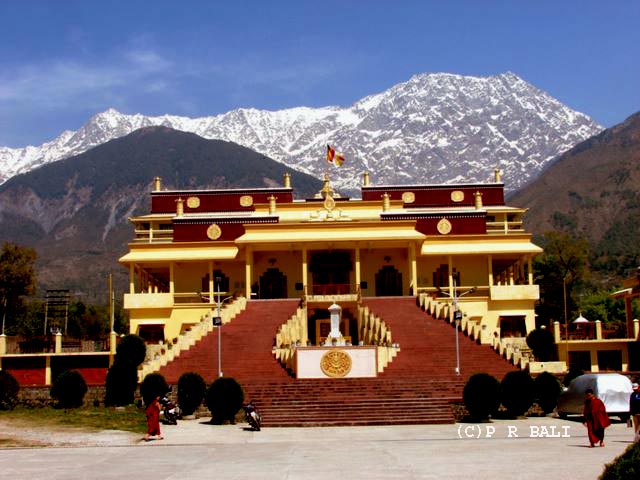
Gyuto
Monastery Sidhbari Dharamsala |
|
|
|
| |
|
9 km up from Kotwali Bazar Dharamsala is the
famous town Mcleodganj often called the ‘Little
Lhasa’. This is the residence of HH the Dalai
Lama. The Tibetan Government in exile has been
here for almost four decades. The impressive
monastery has larger than life images of the
Buddha, Padmasambhava and Avalokteshwara. A large
Tibetan community and the presence of traditional
architectural designs drawn from Tibet have
enhanced the charm of the area. A host of Tibetan
handicrafts and garments are available. |
|
| |
|
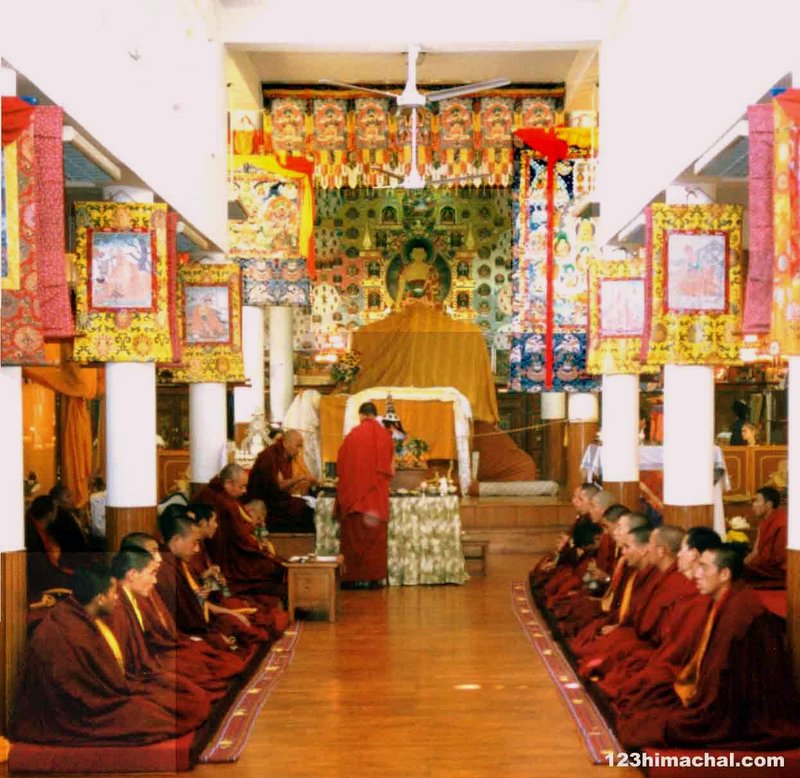 |
Tsuglag Khang (Central Cathedral)
Though a plain and utilitarian
substitute for its far more splendid name sake in
Lhasa, also known as the Jokhang, the Tsuglag Khang is
nevertheless fascinating and peaceful.Situated
opposite the residence of His Holiness the Dalai
Lama,Tsuglag Khang is known to the local Indians as
the Main Temple. It houses three main images: thatof
the Sakyamuni Buddha, Padmasambhava and Avalokitesvara,
the Buddha of Compassion, of whom the Dalai Lama is
the current emanation. The principal image is that of
Sakyamuni Buddha, measuring three metres high and made
of gilded bronze. To its right are the images of
Padmasambhava and Avalokitesvara which are both facing
Tibet.
|
Namgyalma Stupa
Surrounded by prayer wheels, this Buddhist stupa,
is located in the centre of McLeod Gunj. Erected
as a memorial to those Tibetans who lost their
lives fighting for a free Tibet, Namgyalma Stupa
stands as a monument to the determination of a
suppressed people to preserve their distinctive
way of life against overwhelming odds. With a
statue of the Sakyamuni Buddha enshrined in a
small chamber, the stupa is built in the tradition
of the third century Indian Emperor Ashoka and
represents peace and progress. Day and night,
devotees turn prayer wheels as they circumambulate
the stupa, reciting mantras.
Church Of St. John In The Wilderness
Fifteen minutes' walk from McLeod Gunj, the
Anglican church lies in the forest near Forsyth
Gunj. This neo-Gothic stone church was built in
1852 and has some fine Belgian stained-glass
windows. It miraculously survived the 1905
earthquake - only the spire collapsed. A memorial
to Lord Elgin stands in the churchyard. The
British Viceroy died in Dharamsala and is buried
here. Visiting hours for the church and cemetery
are 10 am to 5 pm each day.
Dal Lake
About three kilometers from McLeod Gunj and next
to the Tibetan Children's Village, this small lake
is brownish in colour and not nearly as impressive
as the name and reputation suggest. However, there
are many interesting walks around the lake.
|
|
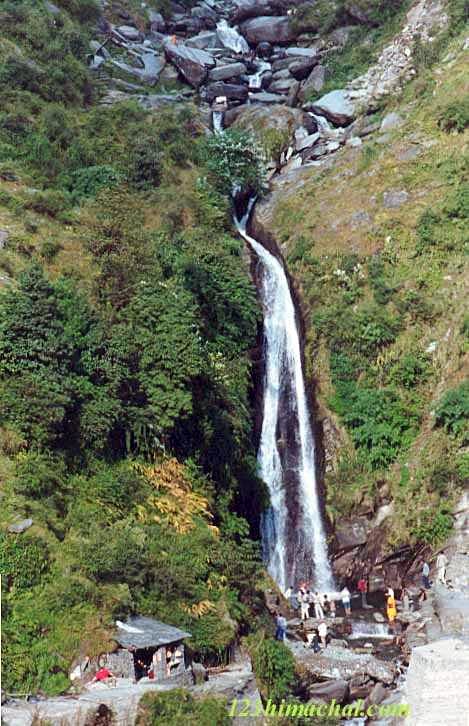 |
Bhagsunag
This ancient temple is 2 kms from Mcleodganj.. Close
to this temple is a beautiful waterfall.Near the Dal
Lake is the shrine of Bhagsunath an easy walk from
the Mecleod ganj. Famous for its ancient temple and
a pretty waterfall not far away. The rock temple
dedicated to local Goddess is just 3 km from Kotwali
Bazaar.
Dharamkot
This village, twenty minutes' walk further up the
hill from McLeod Gunj, is a favourite picnic spot
with a panoramic view of the Kangra Valley. It is
possible to rent houses from local Indians if you
are planning a longish stay.
|
|
|
Triund
Mcleodganj to Triund is a 9 km gradual trek which passes
through the Dharmkot and Rakkar villages. The tracks
from Rawa, Dal lake, Dharamkot and Bhagsu meet at a
ridge known as Galu Devi (2130m) which has a small
temple and a water point. From Galu Oevi onward the
track is smooth and clear and ascends through a mixed
forest of oaks and rhododendrons. The track then
gradually gains height and winds round the ridges
looking towards Dharamsala and the Kangra valley. The
last climb after a snow nullah rises abruptly with steep
ascents and the track weaves through twenty two curves
making the ascent tiring and difficult. On this track
one can spot many types of birds. Monals are in plenty.
The black bear, leopards, pigs and wild goats are also
found in this region. There is a small forest bungalow
at Triund located on a big and green subsidiary ridge of
the Dhauladhar range. The forest bungalow was built some
years ago. |
| |
|
|
Naam Art Gallery
Location Sidhbari Dharamsala |
|
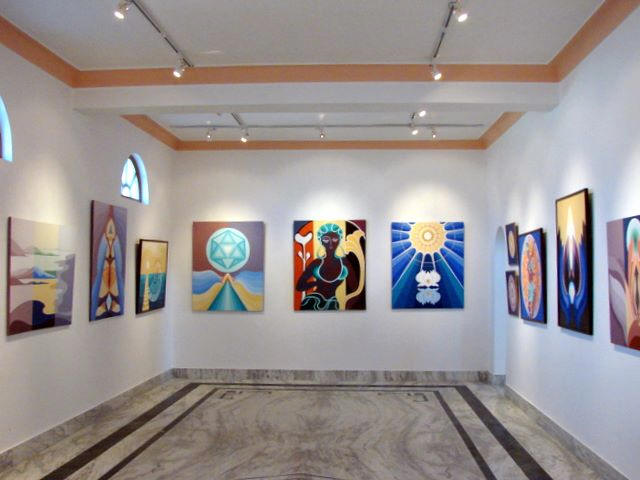 |

MORDEN ART BY EUROPEAN ARTISTS
The
permanent exhibition in ‘NAAM ART GALLERY’ exhibit
paintings by Elsbeth Buschmann - watercolours
,acrylics and oil paintings by Alfred W. Hallett.
Gallery
Timing: 10 am to 7 pm (Monday closed) (M) 9816043708
|
|
|
|
Norbulingka |
The Norbulingka Institute The Norbulingka Institute
of Tibetan Culture was founded by the
Department of Religion and Culture to
preserve and promote Tibetan art and culture
in exile. It derives its name from the His
Holiness the Dalai Lama's beautiful summer
residence, the Norbulingka (Jewel Garden),
set in parkland two kilometers from
Lhasa.Fearing for the future of Tibet's
cultural heritage, the Seventh Dalai Lama,
Kelsang Gyatso, established institutes of
arts and science there in 1754.Today, with
occupied-Tibet undergoing the bleakest
period in its history, the Norbulingka
Institute in Dharamsala has taken the
initiative to preserve the roots of Tibetan
culture in exile. The institute is sited in
a scenic valley below Dharamsala.
|
|
Chinmaya Tapovan:-
An
ashram complex has been established by late Swami
Chinmayananda, a noted exponent of the Gita, at a
distance of approximately 10 km from Dharamsala on the
banks of the rivulet Bindu Saras. The complex includes a
9 m high image of Lord Hanuman, a magnificent Rama
temple, a meditation hall, a school, and a health and
recreation centre.
Kangra |
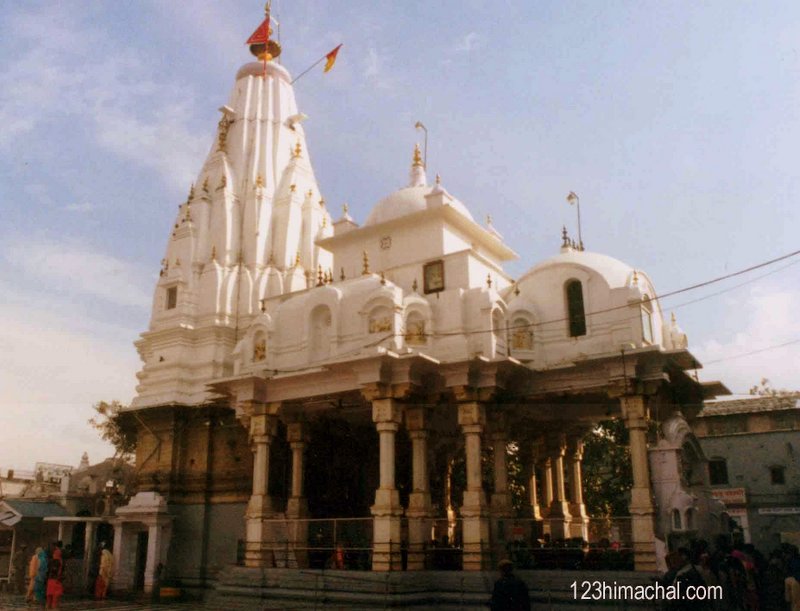 |
Kangra town is 18 km from Dharamsala. This was the first
seat of Raja Sansar Chand II (1775-1823) .One of the
ancient capital of powerful hill state-fort of
Nagarkot(3km) stands as a mute witness to the ravages of
conquerors from Mahmood of Ghazni to the Emperor
Jehangir, and the disastrous earthquake of 1905. The
place is now called "Purana Kangra".2 km from the bus
stand is the temple dedicated to the goddess Barjeshwari
Devi.
|
|
Barjeshwari Temple |
| |
Tatwani & Machhial (500 mt)
20 km fro Dharamsala and 4 km from Rait (on
Dharamsala-Pathankot Road) is the beautiful waterfall. 5
km down lies the hot spring
of Tatwani (a contraction of Tatta pani) on the bank of
Gaj rivulet, a tributory of Beas. The hot spring issues
at a height of about five feet from the side of the
hill.
Chamunda
Another 20 km from Kangra is the famous Chamunda
Nandikeshwar dham. This place also has a beautiful
bathing ghat and a small temple across the bridge
joining the ghat. There are ample arrangements to stay
in the temple sarai and the rest house at Dadh. Up in
the Dhauladhar hills, a trek of about 16 km, is the
place where Bhagwati Chamunda, according to the Puranas,
Vanquished the demons Chand and Munda.
MASRUR- Rock cut Temple
Masrur (800mt)-Masrur is 36 km from Dharamsala on
Nagrota Surian link road and is famous for remarkable
group of rock cut temples. They form a group of 15
monolithic rock cut temples in the Indo Aryan style and
are richly carved. The main shrine contains three stone
images of Ram laxman and Sita but the presence of the
figure of Shiva in the centre of the lintel affors a
strong presumption that the temple was originally
dedicated to Mahadeva.
|
|
|
| |
| |